Wired vs Wireless Headphones
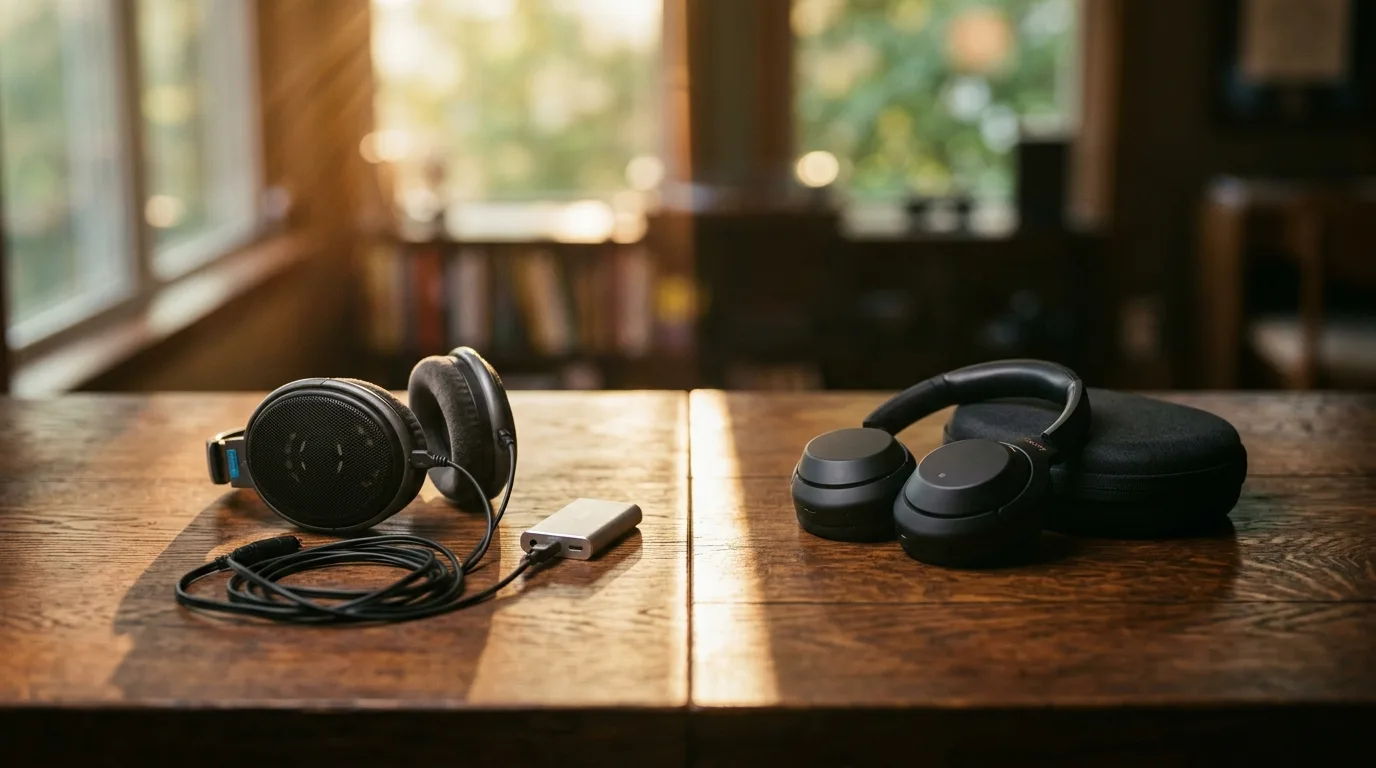
The wired-versus-wireless question used to have an obvious answer: wired for quality, wireless for convenience. In 2026, that framing no longer holds. LDAC pushes 990kbps over Bluetooth. USB-C wired mode delivers lossless digital audio through the same headphones that stream wirelessly. ANC algorithms need battery power that only wireless designs provide. The real question is no longer which sounds better in a vacuum, but which connection type fits the way you actually listen — and whether the headphones you are considering let you switch between both.
This page compares wired and wireless headphones across five measurable dimensions: sound quality at the codec level, latency for gaming and video sync, daily convenience, battery life impact, and reliability. We referenced latency measurements from RTINGS, codec bitrate specifications from the Bluetooth SIG and Qualcomm, and owner-reported reliability data across 18,000+ Amazon reviews. The goal is to give you enough data to know which connection type fits your primary use case — and when it truly does not matter.
Connection Technology Reference
The Core Compromise
Wired headphones deliver zero compression and under 5ms latency through a physical cable. Wireless headphones compress audio into a Bluetooth codec, adding 40-200ms of delay and discarding data at each step. That gap has narrowed — LDAC now streams at 990kbps, and aptX Adaptive hits 420kbps at 50-80ms — but the underlying exchange between fidelity and freedom remains.
Five years ago, Bluetooth audio topped out at SBC's 345kbps with 150-250ms of delay. The ceiling has risen high enough that most listeners cannot identify the wireless signal in blind comparisons when the source is a standard streaming file. The compression penalty that once defined wireless headphones has shrunk to a margin that matters only at the extremes of source quality and listener training.
The exchange cuts in both directions. Wired connections sacrifice freedom of movement, add cable microphonics (the thud of a cable tapping your shirt), and require a headphone jack that most phones no longer include. Wireless connections sacrifice absolute latency, rely on battery charge, and compress audio — but deliver ANC, multipoint Bluetooth pairing, touch controls, and the physical untethering that makes headphones viable during commutes, workouts, and household movement. Neither side concedes to the other on every dimension. The winner depends on which dimension matters most in your daily listening.
Sound Quality: Wired vs Wireless in 2026
Sound quality differences between wired and wireless listening come down to the codec ceiling and the source file bitrate. A wired connection transmits whatever signal the source sends — if the source is a 1,411kbps CD-quality file, every bit reaches the headphone driver. A Bluetooth connection compresses that same file to fit within the codec's bitrate cap: 345kbps for SBC, 256kbps for AAC, 420kbps for aptX Adaptive, and 990kbps for LDAC. The compression is lossy — audio data is permanently discarded based on psychoacoustic models that predict which frequencies the ear is least likely to detect.
Here is why the codec ceiling matters less than it appears. Spotify Premium streams at 320kbps in OGG Vorbis. Apple Music lossy streams at 256kbps AAC. YouTube audio maxes at 256kbps. These are the sources most listeners use most of the time. LDAC at 990kbps transmits these streams without additional compression — the source is already more compressed than the wireless link. Even AAC at 256kbps matches Apple Music's lossy bitrate exactly. The codec bottleneck only activates when the source exceeds the codec's ceiling: FLAC files, Tidal HiFi lossless streams, or Apple Music Lossless tracks played from local storage. For the majority of wireless listeners streaming from Spotify or Apple Music at default quality, the difference between wired and Bluetooth at AAC or higher is not something the human ear reliably detects.
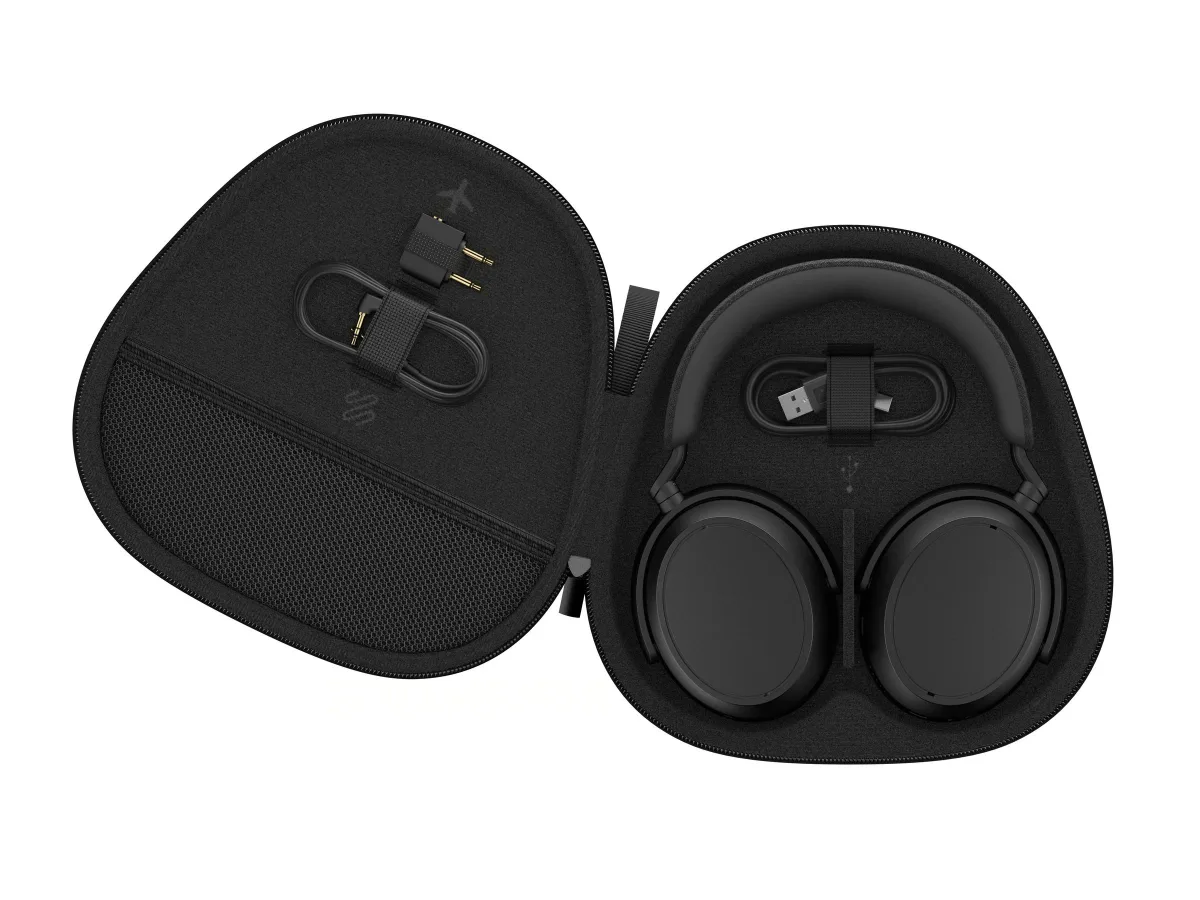
The Sony WH-1000XM6 demonstrates this convergence. In wireless LDAC mode at 990kbps, it delivers the full Spotify stream without additional compression. Switch to the included 3.5mm cable with a lossless FLAC file, and trained ears may detect marginally better transient response and a wider stereo image on complex orchestral passages. On a pop track streamed from Spotify, the wired and wireless presentations are functionally identical. Our Bluetooth codec breakdown covers the bitrate math in detail if you want the full technical picture.
USB-C wired audio changes the equation. The Beats Studio Pro and Bose QuietComfort Ultra both accept lossless digital audio over USB-C, bypassing Bluetooth compression entirely while keeping the headphone's internal DAC and amplifier in the signal chain. This is a genuine middle ground — the convenience of a single USB-C cable (which also charges the headphone) with the audio fidelity of a wired connection. The digital signal avoids the analog noise floor that 3.5mm cables pick up from phones with weak headphone amplifiers. For listeners who care about lossless audio but do not want to carry a separate DAC, USB-C wired mode is the best option currently available for high-fidelity portable listening.
Transmission Delay and Real-Time Audio Performance
Latency: When Milliseconds Matter
Latency is the delay between an audio event at the source and the sound reaching your ear. A wired analog connection introduces under 5ms of delay — fast enough that no human perceives it. Bluetooth adds substantially more, and the amount depends entirely on the codec negotiated between your phone and headphone.
The measured ranges from RTINGS and published codec specifications: SBC averages 150-250ms. AAC averages 90-150ms. Standard aptX delivers roughly 70ms. aptX Adaptive in low-latency mode drops to 50-80ms. LDAC at 990kbps quality-priority mode averages 200ms or more, because it prioritizes bitrate over speed. A 2.4GHz wireless dongle — the type bundled with gaming headsets — operates at 15-30ms, approaching wired territory without a physical cable.
Where these numbers matter: video playback becomes noticeably out of sync above 80ms. Most video players compensate with audio delay buffers, but the compensation is imperfect and varies by app. Competitive multiplayer gaming requires sub-30ms audio for accurate spatial positioning — footstep direction in a shooter, audio cue timing in a rhythm game. Casual video watching tolerates 40-80ms before lip-sync becomes distracting. Music listening has no latency sensitivity because there is no visual reference for the brain to compare against.
The Sennheiser Momentum 4 with aptX Adaptive provides the best wireless latency-to-quality ratio for mixed media consumption. Its low-latency mode keeps delay under 80ms while maintaining 420kbps audio quality — tight enough for video sync and YouTube, fast enough that most listeners never notice the gap. For studio monitoring, video editing, or competitive play where every millisecond matters, a wired connection is still the only option that meets professional latency requirements. Our wireless gaming roundup ranks headsets by measured latency for players who need the numbers.
Gaming Latency in Practice
The latency numbers above become concrete in specific gaming scenarios. In a competitive first-person shooter, a gunshot fired 10 meters away reaches the player character in roughly 30ms of in-game time. If the headphone adds 150ms of Bluetooth delay on top, the audio cue arrives after the visual damage indicator — the player sees they have been hit before hearing the shot. At 50ms (aptX Adaptive low-latency), the audio and visual stay close enough that most players perceive them as simultaneous. Below 20ms (wired or 2.4GHz dongle), the sync is indistinguishable from zero delay.
Rhythm games punish latency more harshly than any other genre. Titles like Beat Saber, Hi-Fi Rush, and Osu! score timing in windows as narrow as 16ms for a "perfect" hit. Bluetooth at 80ms puts every input roughly 5 frames late on a 60Hz display — the player must internalize an offset and swing early to compensate. Most rhythm games offer audio offset calibration, but compensating for 150ms+ of SBC delay pushes the calibration beyond what feels natural. Wired monitoring with sub-5ms latency eliminates the problem entirely. Players who split time between rhythm games and casual titles often keep a short 3.5mm cable in their desk drawer for exactly this reason.
Music Production and Studio Monitoring
Professional audio production has the strictest latency tolerance of any headphone use case. When a vocalist records over a backing track, they hear their own voice through the headphone monitoring chain. If that chain adds 40ms of delay, the vocalist hears themselves singing roughly a sixteenth note late at 120 BPM — enough to throw timing and pitch. Studio engineers call this monitoring latency, and the professional threshold is under 10ms round-trip. No Bluetooth codec meets this. A wired connection through a dedicated audio interface delivers 3-5ms, which is perceptually instant.
The same constraint applies to electronic music producers triggering samples, guitar players monitoring through amp simulators, and podcast editors scrubbing audio for precise cuts. Any task where the user's physical action must sync with what they hear in the headphone demands wired monitoring. The Sony WH-1000XM6 in 3.5mm wired mode serves this role — the drivers are capable, and the cable bypasses the entire Bluetooth stack. But dedicated studio headphones from Audio-Technica, Beyerdynamic, and Sennheiser's HD series remain the standard because they are built for wired use from the ground up, with replaceable cables, wider frequency response, and flatter tuning curves that reveal mixing errors rather than flattering the listener.
Convenience and Daily Use
The convenience gap between wired and wireless has widened in favor of wireless every year since 2016, when Apple removed the headphone jack from the iPhone 7. Most Android flagships followed. In 2026, using wired headphones with a modern phone requires a USB-C to 3.5mm adapter — a small dongle that blocks the charging port, gets lost in bags, and adds a failure point to the audio chain. The adapter problem alone pushed millions of buyers toward wireless. Wireless headphones pair once and reconnect automatically every time you open the case or power on.
Multipoint Bluetooth multiplied the convenience advantage. The Sony WH-1000XM6, Bose QuietComfort Ultra, and Sennheiser Momentum 4 all connect to two devices simultaneously — laptop and phone, tablet and phone, desktop and phone. When a call arrives on your phone during a laptop music session, the headphone switches automatically. No cable swapping. No re-pairing. This feature alone makes wireless headphones the default for remote workers, and it has no wired equivalent. A cable plugs into one device at a time. Period.
Touch controls, voice assistant integration, and companion app EQ customization exist only on wireless headphones. Wired headphones with inline remotes offer play/pause and volume — nothing more. ANC requires battery power and onboard processing that only wireless headphones provide. Transparency modes that let ambient sound through electronically are a wireless-only feature. The entire feature stack of a modern premium headphone depends on the wireless platform. Using a cable on the Sony WH-1000XM6 disables ANC, EQ profiles, spatial audio, and touch controls — the headphone becomes a passive driver in a plastic shell.
Wired convenience wins in one scenario: simplicity. Plug in, audio plays. No pairing, no charging, no codec negotiation, no app required. For studio musicians switching between instruments and monitors, for live performers who need zero-latency monitoring, and for desktop listeners who never move their headphones — a cable is simpler, more reliable, and eliminates battery anxiety entirely. The JBL Tune 520BT — a wireless-only model with no 3.5mm input — becomes a paperweight when its battery dies. A wired headphone cannot run out of power.
Battery: The Wireless Tax
Every wireless headphone carries a lithium-ion battery that adds weight, limits lifespan, and introduces a maintenance cycle that wired headphones do not have. The battery is the single largest reliability difference between the two connection types.
Current battery endurance across the products in this comparison: the Sennheiser Momentum 4 leads at 60 hours with ANC active. The Sony WH-1000XM6 delivers 40 hours. The Bose QuietComfort Ultra runs for 24 hours. The JBL Tune 520BT reaches 57 hours without ANC (it does not have ANC). The Beats Studio Pro delivers 40 hours. These are manufacturer ratings under controlled conditions — real-world usage with LDAC, high volume, and frequent ANC mode switching typically reduces runtime by 15-25%.
Quick-charge mitigates the dead-battery problem. Most premium models recover 3-5 hours of playback from a 5-10 minute USB-C charge. The Sony WH-1000XM6 delivers 3 hours from a 3-minute charge. This changes the calculus for daily users — a morning commuter who forgot to charge overnight can plug in during breakfast and have enough power for the round trip.
The long-term battery concern is capacity degradation. Lithium-ion cells lose capacity with every charge cycle. After 500 full cycles — roughly 2-3 years of daily use — most wireless headphones retain 70-80% of original battery capacity. After 4-5 years, degradation becomes noticeable: a headphone rated for 40 hours may deliver 25-30. Battery replacement is possible on some models but requires disassembly that most users will not attempt. A wired headphone from 2010 still sounds the same as it did on day one. A wireless headphone from 2021 has lost measurable battery capacity. This is the wireless tax — ongoing maintenance and eventual obsolescence built into the design.
Durability and Repairability
Wired headphones have fewer components that can fail. No battery to degrade, no Bluetooth antenna, no charging port, no touch-sensitive surface. The failure modes are mechanical: cable fraying at the plug or Y-split, headband cracking at the hinge, and ear pad compression. All three are repairable. Replacement cables cost $8-25 for detachable models. Third-party ear pads run $10-20. Headband padding can be re-wrapped. A well-maintained wired headphone from 2015 can sound identical to the day it was purchased, because the drivers themselves rarely fail under normal use.
Wireless headphones add a ticking clock: the lithium-ion battery. After 500 charge cycles, capacity drops to 70-80% of original. After 1,000 cycles, some units struggle to hold a charge through a commute. Battery replacement on over-ear models like the Sony WH-1000XM6 is technically possible — teardown guides exist — but requires disassembly, a compatible replacement cell, and soldering in some cases. Most consumers treat a dead battery as the end of the headphone's life. True wireless earbuds are worse: the batteries in individual buds are too small and too tightly integrated for practical replacement. When a true wireless earbud battery dies, the earbud is functionally disposable.
The repairability gap extends to software. Wireless headphones depend on firmware for codec negotiation, ANC tuning, and companion app features. When a manufacturer stops issuing firmware updates — typically 3-4 years after a product launches — the headphone freezes at its last software version. Future phone OS updates can break Bluetooth compatibility. A wired headphone has no firmware, no app dependency, and no software expiration date. The 3.5mm jack is a 60-year-old standard that has not changed and will not change.
When Wired Still Wins
Studio monitoring. Professional audio engineers mixing music, editing film dialogue, or mastering tracks need sub-5ms latency with zero compression artifacts. No Bluetooth codec meets this requirement. Studio headphones are wired by necessity, not by tradition.
Competitive gaming at the tournament level. Esports competitors use wired headsets or 2.4GHz wireless dongles. Bluetooth latency — even aptX Adaptive's 50ms floor — introduces enough audio delay to affect reaction time in games where 30ms separates a hit from a miss. The wired advantage here is measurable and competitively meaningful.
Audiophile critical listening with lossless sources. If you own a dedicated DAC/amplifier, stream Tidal HiFi or play local FLAC files, and listen in a quiet room on reference-grade headphones, wired delivers the complete signal chain without codec intervention. The Sony WH-1000XM6 in wired mode with LDAC defeated still outperforms its own Bluetooth connection on demanding classical recordings — the difference is subtle, but real and repeatable in controlled comparisons.
Dead-battery rescue. When a wireless headphone runs out of charge, a 3.5mm cable turns it back on as a passive wired headphone. The Sennheiser Momentum 4 and Sony WH-1000XM6 both include this cable. The JBL Tune 520BT does not — when its battery dies, it produces no sound at all. For travelers on long flights or listeners who forget to charge, a headphone with a wired fallback eliminates the single point of failure.
When Wireless Wins
Daily commuting. Cable management on public transit — threading a wire through coat layers, avoiding snag points on bag straps, keeping the cable clear of doors — is a solved problem. Wireless eliminates it entirely. ANC, which requires the battery and processing power of a wireless platform, transforms a loud subway car into a private listening space. The Bose QuietComfort Ultra on a morning commute delivers an experience that no wired headphone can match, because the noise cancellation is the product, not just the audio playback.
Exercise and outdoor activity. Cables during physical movement are a liability — they snag on equipment, bounce with each stride, and transmit impact vibration as low-frequency thuds (cable microphonics). Wireless earbuds and bone conduction headphones exist because cables failed athletes. Sweat resistance ratings (IPX4-IP55) and secure-fit designs (wing tips, ear hooks, wraparound bands) are wireless-only innovations driven by the active use case.
Multi-device workflows. Remote workers switching between laptop video calls and phone notifications need multipoint Bluetooth. Wired headphones connect to one device at a time, and switching requires physically unplugging and re-plugging. With the Sony WH-1000XM6 paired to both a MacBook and an iPhone, the transition is automatic and inaudible. This alone justifies wireless for anyone who uses a headphone across two or more devices daily.
Household freedom. Cooking with a podcast playing, moving between rooms during a phone call, walking the dog while listening to an audiobook — these mundane daily activities work with wireless and do not work with a cable tethered to a phone in your pocket. The cable reach problem disappears, and with it the constant awareness of where your phone sits relative to your head. See our premium noise-cancelling picks for models that handle all-day mixed use across these scenarios.
Now That You Know
The wired-versus-wireless decision narrows your search significantly. Three directions from here depending on where you land:
Leaning wireless with top-tier ANC: Our premium noise-cancelling headphone roundup ranks every flagship by ANC depth, codec support, battery marathon, and comfort — the specs that define the wireless experience.
Want the best of both connections: The XM6 vs Bose QC Ultra comparison tests the two headphones that offer the strongest wired-and-wireless dual-mode experience, including USB-C lossless measurements.
Choosing your first wireless pair: Our wireless headphone buying framework walks through form factor, budget tiers, and use-case matching — starting from zero assumptions about what you need.
Full codec specs, bitrate tables, and phone compatibility: headphonecurve.com/bluetooth-codecs-explained/

Frequently Asked Questions
Do wireless headphones sound worse than wired?
Not in most real-world listening. LDAC at 990kbps and aptX Adaptive at 420kbps transmit enough data that the wireless link is no longer the bottleneck for streaming audio at 128-320kbps. The gap is audible only when comparing a wired connection to Bluetooth SBC at 229kbps on demanding lossless source files through resolving headphones. For Spotify, Apple Music lossy, or podcast listening, modern wireless headphones like the Sony WH-1000XM6 are indistinguishable from wired mode in controlled listening tests.
Can I use wireless headphones wired for lower latency?
Yes, if the headphone includes a 3.5mm or USB-C audio input. The Sony WH-1000XM6, Bose QuietComfort Ultra, and Sennheiser Momentum 4 all include a 3.5mm cable in the box. Plugging in bypasses Bluetooth entirely, dropping latency from 40-200ms to under 5ms. USB-C wired audio on the Beats Studio Pro also bypasses Bluetooth and delivers lossless digital audio. Not all wireless headphones offer a wired fallback — the JBL Tune 520BT is wireless-only with no analog input.
Is Bluetooth latency bad enough to affect gaming?
For competitive multiplayer, yes. Bluetooth latency ranges from 40ms (aptX Adaptive low-latency) to 200ms+ (LDAC quality mode). Competitive first-person shooters require sub-30ms audio sync for accurate spatial cues. A 2.4GHz wireless dongle delivers 15-30ms — acceptable for most players. A wired USB-C or 3.5mm connection delivers under 5ms. For casual single-player titles and turn-based games, Bluetooth latency at 40-80ms is unnoticeable. For rhythm games where timing is scored, even 40ms creates a perceptible offset.
Why do some wireless headphones include a 3.5mm cable?
The cable serves three purposes. First, it enables passive listening when the battery dies — plug in and the drivers still produce sound without power (ANC and EQ features stop working). Second, it provides zero-latency audio for studio monitoring, video editing, and competitive gaming. Third, it connects to devices without Bluetooth — airplane seatback screens, older receivers, gym equipment displays. The Sennheiser Momentum 4 and Sony WH-1000XM6 both include a cable for this reason. Budget wireless models increasingly omit it to cut costs.
Does USB-C audio on headphones mean lossless sound?
USB-C can carry lossless digital audio, but the headphone must support USB-C audio mode specifically — not just USB-C charging. The Beats Studio Pro and Bose QuietComfort Ultra both support lossless USB-C audio input, transmitting an uncompressed digital stream directly to the internal DAC. This bypasses Bluetooth compression entirely and delivers true bit-perfect audio. Most budget wireless headphones use USB-C only for charging and do not support audio over the same port.
Get Picks Delivered
One email per week. Honest reviews, no spam.
Only when something changes. Unsubscribe anytime.