Wireless Headphone Features Explained
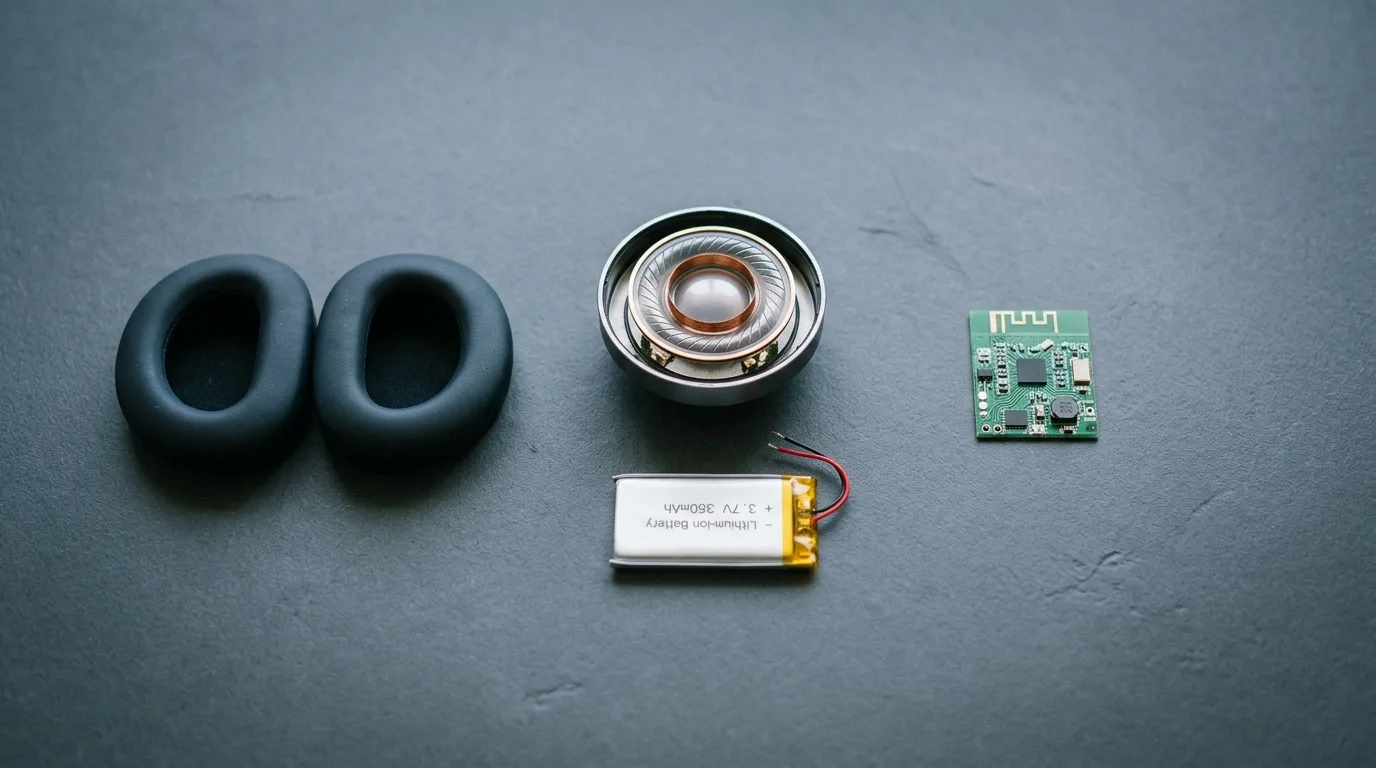
Wireless headphones now ship with feature lists that read like technical specifications for networking equipment. LDAC, aptX Adaptive, multipoint, spatial audio, adaptive ANC, wear detection, and companion app EQ all compete for attention on the back of every box.
This guide decodes each feature in plain language, ranks them by how much they affect daily listening, and identifies which buyer profiles actually benefit from each one. We pulled data from manufacturer specs, codec documentation, and hands-on measurement databases including RTINGS and SoundGuys. The result is a feature-by-feature map that separates the specs worth paying for from the ones that exist primarily as marketing line items. If you are buying your first wireless pair or upgrading from a model that is three years behind, the breakdown below tells you where your money goes — and where it gets wasted on features you will never notice.
Feature Reference Overview
Why Wireless Headphone Features Matter More Than Brand
A wireless headphone feature is any hardware capability or software function that affects how the headphone performs outside of basic music playback. Features determine if your headphones connect to two devices at once, cancel background noise adaptively, or stream audio at studio-adjacent quality over a wireless link.
Two headphones at the same price point can differ wildly in feature sets. One model may include LDAC codec support, multipoint pairing, and adaptive noise cancellation, while another at an identical price skips all three. Brand prestige does not predict feature completeness — a mid-priced headphone from one manufacturer can outspec a premium model from another. The Sony WH-1000XM6 currently packs the widest feature set of any wireless headphone on the market: LDAC, multipoint, adaptive ANC, spatial audio, quick charge, USB-C wired mode, and a companion app with 10-band EQ. Our full XM6 review breaks down performance across each of those features. The Bose QuietComfort Ultra matches on ANC quality and multipoint but skips LDAC entirely — a gap that matters if you use Android with lossless streaming. See our XM6 versus Bose QC Ultra comparison for the full feature-by-feature breakdown.
Knowing which features solve your specific problems prevents overpaying for capabilities you will never use — and prevents underpaying for features you will miss every day. We recommend prioritizing ANC quality and multipoint over codec specs for most buyers.
Bluetooth Codecs: The Invisible Quality Cap
A Bluetooth codec compresses audio for wireless transmission between your phone and headphones. The codec your headphones support sets the maximum quality ceiling — no amount of driver engineering compensates for a low-bitrate wireless link. Four codecs dominate the current market, each with different bitrate limits, latency profiles, and device compatibility requirements.
SBC (Sub-Band Coding) is the baseline codec every Bluetooth audio device supports. It transmits at 328kbps in standard mode, adequate for spoken podcasts and casual music but noticeably compressed on complex instrumental passages. SBC is the fallback — your headphones use it when no higher codec is available on the connected device.
AAC (Advanced Audio Coding) transmits at up to 256kbps and is Apple's default Bluetooth codec. On iPhones, AAC is well-optimized and produces cleaner results than SBC. On Android, AAC quality varies by device manufacturer because Google does not mandate a specific AAC encoder quality. If you use an iPhone, AAC is your wireless ceiling regardless of what codecs your headphones advertise.
aptX Adaptive (Qualcomm) transmits up to 420kbps with variable bitrate that adjusts to connection stability. Its advantage over LDAC is lower latency — useful for video watching and mobile games where audio-visual sync matters. aptX requires a Qualcomm chipset in both the headphone and the source device. The Sennheiser Momentum 4 supports aptX Adaptive, and our Momentum 4 versus XM5 comparison measures the codec difference in blind listening tests.
LDAC (Sony) transmits up to 990kbps — roughly triple the bitrate of AAC. It is the highest-quality Bluetooth audio codec available and is supported on Android devices natively. LDAC makes a measurable difference when streaming lossless content from Tidal HiFi or playing local FLAC files. At its maximum 990kbps setting, trained listeners consistently identify LDAC as closer to wired quality in ABX tests. The Sony WH-1000XM6 and Anker Soundcore Space One both support LDAC — the latter at a fraction of the price. For the full bitrate and latency breakdown across all five codecs, see our Bluetooth codec deep dive.
Multipoint Bluetooth: Two Devices, Zero Hassle
Multipoint Bluetooth maintains active connections to two source devices simultaneously. Your headphones stay paired to both your phone and your laptop at the same time. When a phone call arrives during a laptop music session, audio switches to the call without you touching a button or opening Bluetooth settings.
This feature eliminates the disconnect-reconnect cycle that remote workers endure multiple times per day. Without multipoint, switching from laptop audio to phone audio requires opening Bluetooth settings on one device, disconnecting, then connecting on the other. With multipoint, the transition is automatic. The Sony WH-1000XM6, Bose QuietComfort Ultra, and Sennheiser Momentum 4 all support multipoint. Among affordable options, the Tune 520BT at its current price includes multipoint — a feature that was limited to premium models two years ago.
If you work from home and regularly switch between phone calls and computer audio, multipoint belongs near the top of your priority list. If you use headphones with only one device, it provides no practical benefit.
Spatial Audio and Head Tracking: The 3D Sound Promise
Spatial audio processes stereo or multi-channel recordings into a three-dimensional sound field around your head. Head tracking adds a second layer — as you turn your head, the sound stage stays fixed relative to the screen or speaker position, creating the illusion that sound comes from a physical location in the room rather than from inside your headphones.
Apple Spatial Audio works with Dolby Atmos content on Apple Music and requires AirPods or Beats headphones paired with an Apple device. The Apple AirPods Pro 3 delivers the most refined implementation — head tracking is responsive and the spatial placement of instruments in Atmos mixes feels accurate. Our AirPods Pro 3 versus Sony earbuds comparison tests spatial audio across both platforms.
Sony 360 Reality Audio uses a different spatial format supported on Tidal and Amazon Music. It requires Sony headphones and the Sony Headphones Connect app. The Sony WH-1000XM6 and Sony WH-1000XM5 both support it, though the library of 360 Reality Audio tracks remains smaller than Apple's Atmos catalog.
Who actually needs spatial audio? Movie and TV watchers benefit the most — Dolby Atmos content on streaming platforms creates a convincing surround effect. Music listeners get a mixed result: Atmos remixes of albums can sound spacious and layered, or they can sound oddly hollow and detached from the original stereo mix. Spatial audio is a bonus feature, not a buying criterion. No headphone purchase should hinge on spatial audio alone.
Transparency and Ambient Sound Modes
Transparency mode uses built-in microphones to capture environmental sound and mix it with your music. The effect lets you hear conversations, traffic, and announcements without removing your headphones or pausing playback. Every major manufacturer implements this feature under a different name: Apple calls it Transparency, Sony uses Ambient Sound, Bose labels it Aware Mode, and Samsung names it Ambient Sound.
Quality varies more than any other feature in this guide. The Apple AirPods Pro 3 produces the most natural transparency — voices sound clear, wind noise is filtered, and the digital processing is nearly invisible. The Bose QuietComfort Ultra ranks close behind with clear voice passthrough and minimal artifacts. Mid-priced models like the Anker Soundcore Space One deliver functional transparency but with audible digital coloring — voices carry a slight metallic edge, and background noise has a compressed quality.
Adaptive transparency is the next iteration. The Apple AirPods Pro 3 automatically reduces passthrough volume when a sudden loud sound occurs (construction, ambulance siren) to protect your hearing, then returns to normal passthrough levels when the noise passes. This is different from standard transparency, which passes all sound at a fixed volume regardless of intensity.
If you wear headphones while walking in urban environments, commuting on public transit, or working in a shared office, transparency quality matters. If you listen primarily at home in quiet spaces, the feature is irrelevant to your daily use.
Adaptive ANC vs Standard Noise Cancellation
Standard active noise cancellation applies a fixed cancellation level that you set manually — off, low, medium, or high. It works well in consistent environments but requires manual adjustment when you move between a quiet office and a loud subway platform. Adaptive ANC reads ambient noise levels through the microphones and adjusts cancellation strength automatically, multiple times per second.
The Sony WH-1000XM6 uses an upgraded adaptive processor with 8 microphones feeding real-time ambient analysis. Walking from a quiet hallway into a crowded cafeteria, cancellation ramps up within seconds. Stepping outside into wind, the algorithm detects wind pattern noise and engages wind-reduction filtering. The Bose QuietComfort Ultra achieves comparable adaptive performance with a different algorithmic approach. Both outperform any fixed-level ANC headphone in environments with variable noise.
The Anker Soundcore Space One offers adaptive ANC at a much lower price. The adaptation range is narrower — it handles moderate noise transitions well but maxes out sooner in extreme environments like airplane cabins. For office-to-transit commuters who encounter moderate noise variation, the budget adaptive ANC performs adequately. For frequent flyers and subway commuters facing extreme noise, the premium adaptive implementations make a measurable difference. Our full ANC buying guide covers feedforward vs hybrid architecture, ANC trade-offs, and which specs predict real cancellation depth.
Wear Detection: Small Feature, Constant Convenience
Wear detection uses proximity sensors or capacitive sensors to detect when headphones are on your head versus around your neck or on a desk. When you remove the headphones, music pauses automatically. When you put them back on, playback resumes from where it stopped. The feature also prevents the common annoyance of headphones draining battery while playing to an empty room after you set them down and forgot to pause.
The Sony WH-1000XM6 and Apple AirPods Pro 3 both include wear detection. The Sennheiser Momentum 4 uses a fold-to-pause mechanism instead — closing the ear cups inward pauses playback. The JBL Tune 520BT and most budget models skip wear detection entirely, which means music keeps playing when you pull them off your ears and battery drains until you manually pause.
Wear detection saves 10-30 seconds of interaction per listening session. Over months of daily use, those seconds compound into a feature you stop noticing when it works but immediately miss when it is absent.
Companion Apps and Custom EQ
Most wireless headphones above the $80 price point include a companion smartphone app. These apps control ANC levels, manage EQ settings, update firmware, and configure feature toggles like multipoint and wear detection. App quality ranges from comprehensive and well-designed to barely functional.
Sony Headphones Connect (for the Sony WH-1000XM6 and Sony WH-1000XM5) offers 10-band parametric EQ, adaptive sound control settings, LDAC priority mode, spatial audio configuration, and speak-to-chat sensitivity. It is the most feature-dense companion app in the category. Bose Music (for the Bose QuietComfort Ultra) provides fewer EQ bands but includes an adjustable noise cancellation slider and SimpleSync for Bose speaker grouping. Apple integrates all headphone controls into iOS Settings — no separate app needed, which is streamlined but limits customization compared to dedicated apps.
The Samsung Galaxy Buds3 Pro uses Samsung's Galaxy Wearable app, which unlocks Samsung-exclusive features including SSC Hi-Fi codec and 360 Audio on Galaxy phones. Outside the Samsung ecosystem, several of these features are unavailable — a pattern that repeats across Apple and Sony products. Check whether the features that interest you require a specific phone brand before purchasing.
If you plan to use the default sound profile without customization, companion app quality is irrelevant. If you want to fine-tune EQ curves, adjust ANC behavior, or access firmware updates, the app becomes a core part of the product experience.
Quick Charge and Battery: The Numbers That Shape Daily Use
Battery life determines whether your headphones last a full day or die mid-afternoon. Over-ear models range from 24 hours (with ANC on) to 60 hours. The Sennheiser Momentum 4 at 60 hours with ANC leads the category — nearly a full work week on a single charge. The Sony WH-1000XM6 delivers 40 hours with ANC, which covers most travel itineraries without charging. Earbuds deliver 5-9 hours per charge from the buds themselves, with charging cases extending total runtime to 24-33 hours.
Quick charge rescues dead headphones in minutes. A 3-minute charge on the Sony WH-1000XM6 adds 3 hours of playback — enough for a morning commute on zero notice. The Sennheiser Momentum 4 adds 6 hours from a 10-minute charge. These numbers matter most for daily commuters and travelers who cannot always charge overnight. For habits that extend battery lifespan over years, see our headphone care and maintenance guide.
All current wireless headphones use USB-C charging. Lightning is gone from the category entirely as of 2025. This means any USB-C phone charger, laptop port, or portable battery works as a headphone charger. USB-C also enables wired audio mode on some models — the Sony WH-1000XM6 supports lossless audio over USB-C when connected to a compatible source, bypassing Bluetooth entirely for maximum quality.
Wireless Range and Connection Stability
Bluetooth 5.0 and newer versions advertise up to 10 meters (33 feet) of range in open air. Real-world range depends on obstacles, interference from Wi-Fi routers and other Bluetooth devices, and the headphone's antenna design. Most wireless headphones maintain stable connections within a single room or floor of a house. Walking to an adjacent room through a wall typically works. Moving two rooms away or to a different floor introduces dropouts.
The Sony WH-1000XM6 uses Bluetooth 5.3 with improved connection stability over the 5.2 spec in the Sony WH-1000XM5. In practice, Bluetooth version matters less than antenna placement and firmware optimization. The Bose QuietComfort Ultra on Bluetooth 5.3 maintains comparably stable connections. Budget models on Bluetooth 5.0 or 5.1 work fine within normal listening range — the stability gap only appears at the edges of Bluetooth range or in interference-heavy environments.
For home listeners, wireless range rarely matters — your phone is usually within arm's reach. For office workers who leave their phone on a desk and walk to a printer or break room, stable range through one or two walls prevents the music-cutting-out annoyance that interrupts workflow.
Common Feature Mistakes That Waste Money
Paying for LDAC when you own an iPhone. Apple does not support LDAC. Period. The codec is invisible to iOS. If your phone is an iPhone, headphones with LDAC do not sound better than headphones without it — both top out at AAC 256kbps. Spending extra for LDAC on an iPhone-only setup is money with zero return.
Prioritizing spatial audio over ANC quality. Spatial audio is a supplementary feature that enhances a small subset of specially mixed content. ANC quality affects every second of every listening session in every environment. A headphone with excellent ANC and no spatial audio improves your daily experience more than one with mediocre ANC and spatial audio support.
Ignoring multipoint for desk-and-phone setups. If you use headphones with a laptop and a phone — which describes most remote workers — lack of multipoint creates daily friction. Manual re-pairing between devices is the kind of minor annoyance that builds into genuine frustration over weeks. Check multipoint support before comparing sound quality specs.
Assuming more features means better sound. Feature count and audio quality are independent variables. The Sennheiser Momentum 4 offers fewer headline features than the Sony WH-1000XM6 but delivers audiophile-tuned sound that many listeners prefer. A headphone with five features you use daily beats one with fifteen features you never touch.
Buying ecosystem-locked features across platforms. Samsung SSC Hi-Fi codec only works with Samsung Galaxy phones. Apple Spatial Audio with head tracking only works with Apple devices. Sony 360 Reality Audio only works through the Sony app. If you switch phone platforms, ecosystem-exclusive features vanish. Prioritize features that work universally — ANC, multipoint, LDAC (on Android), and basic EQ — over features tied to a single manufacturer.
Which Features Deserve Your Budget
For commuters and travelers: Adaptive ANC is the highest-value feature — it handles noise transitions automatically as you move through different environments. Quick charge ranks second for the morning-commute rescue scenario. Multipoint is third if you take calls during transit. Start with our premium noise-cancelling roundup to match these priorities to specific models.
For remote workers: Multipoint Bluetooth is non-negotiable. Wear detection saves daily friction. Companion app EQ lets you optimize for call clarity versus music separately. ANC matters in shared offices but less in home offices. The Sony WH-1000XM6 covers all four priorities, while the Sennheiser Momentum 4 trades app depth for superior audio tuning.
For Android audiophiles: LDAC codec support is the single most impactful feature. Pair LDAC-capable headphones with a lossless streaming subscription and the quality gap over SBC/AAC is audible on first listen. The Sony WH-1000XM6 and Anker Soundcore Space One both support LDAC — our Space One review covers LDAC performance at the budget tier.
For iPhone users: Codec features beyond AAC add nothing. Focus your budget on ANC quality, transparency mode quality, and comfort. The Apple AirPods Pro 3 maximizes Apple ecosystem features including adaptive transparency and Personalized Spatial Audio. If you want over-ear form factor on an iPhone, the Bose QuietComfort Ultra offers premium ANC without wasting budget on Android-only codecs.
For budget buyers: Prioritize the three features with the most daily impact: ANC (even basic), multipoint, and battery life above 30 hours. Skip spatial audio, skip premium codecs, skip wear detection. The Tune 520BT at its current tier includes multipoint and marathon battery without ANC. The Anker Soundcore Space One adds ANC and LDAC at a modest price increase. Our affordable noise-cancelling roundup ranks budget options by ANC depth.
Frequently Asked Questions
What Bluetooth codec gives the best sound quality?
LDAC transmits up to 990kbps — the highest bitrate available over Bluetooth. It is a Sony-developed standard supported on Android devices and select third-party headphones like the Sony WH-1000XM6 and Anker Soundcore Space One. If you stream lossless audio from Tidal or play local FLAC files on an Android phone, LDAC produces an audible improvement over SBC or AAC. On iPhones, AAC at 256kbps is the ceiling regardless of headphone codec support — Apple does not license LDAC.
Is multipoint Bluetooth worth it?
Multipoint lets one headphone maintain active connections to two devices at once — typically your phone and laptop. When a call arrives on your phone during a laptop music session, audio switches automatically without manual re-pairing. For anyone who uses headphones with more than one device daily, multipoint eliminates a repetitive friction point. The Sony WH-1000XM6, Bose QuietComfort Ultra, and Sennheiser Momentum 4 all support it, and even the JBL Tune 520BT at its lower price includes the feature.
Does spatial audio actually improve music listening?
Spatial audio creates a three-dimensional sound stage using head tracking and channel remapping. Apple Spatial Audio works with Dolby Atmos tracks on Apple Music and requires AirPods or Beats. Sony 360 Reality Audio uses a different format on Tidal and Amazon Music. The effect is most noticeable in orchestral, live, and cinematic recordings — less so in standard stereo pop or rock. Most listeners treat spatial audio as a novelty rather than a daily listening mode, but it adds genuine depth to compatible content.
What is the difference between transparency mode and ambient mode?
They are the same feature under different brand names. Apple calls it Transparency Mode, Sony uses Ambient Sound Mode, and Bose calls it Aware Mode. All use the headphone microphones to pipe outside sound through to your ears while music plays. Quality varies: the Apple AirPods Pro 3 produces the most natural-sounding passthrough, where voices sound almost as clear as removing the earbuds entirely. Lower-priced models add a noticeable digital hiss or tinny quality to passed-through audio.
How much does quick charge actually help?
Quick charge adds 3-5 hours of playback from a 5-10 minute charge. The Sony WH-1000XM6 delivers 3 hours from a 3-minute charge. The Sennheiser Momentum 4 adds 6 hours from a 10-minute charge. This feature rescues dead headphones before a commute or flight — it does not replace overnight charging for daily use. USB-C is now universal across all current wireless headphones, so any phone charger works. Lightning is gone from the headphone market entirely.
Do I need adaptive ANC or is standard ANC enough?
Standard ANC applies a fixed level of cancellation. Adaptive ANC adjusts cancellation strength in real time based on ambient noise levels — stronger on a subway, lighter in a quiet office. The Sony WH-1000XM6 and Bose QuietComfort Ultra both use adaptive ANC. The practical difference: standard ANC sometimes over-cancels in quiet rooms (creating an uncomfortable vacuum sensation) or under-cancels in loud environments. Adaptive ANC handles transitions between environments without manual adjustment. For commuters who move between indoor and outdoor spaces throughout the day, adaptive ANC removes the need to toggle modes.
Our Top Recommendation
Based on our research, the Sony WH-1000XM6 is our top pick — android users who want the absolute best anc and detailed sound without apple ecosystem dependency.
Get Our Top 3 Picks
Get our top 3 picks for your budget — one email, then only updates.
Only when something changes. Unsubscribe anytime.