How to Choose Wireless Headphones in 2026
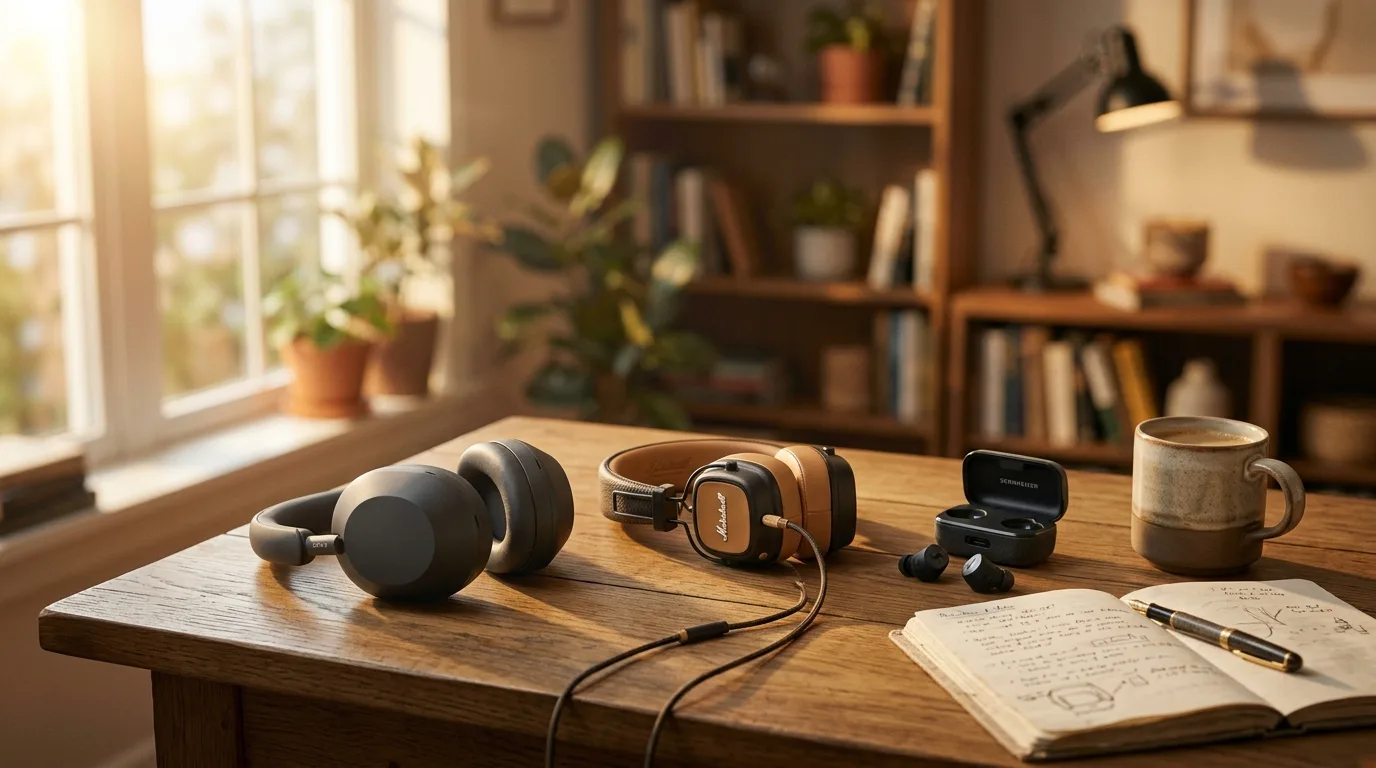
Wireless headphones span four form factors, three ANC tiers, and prices from $30 to $550. This guide maps your listening habits to the right product category.
We distilled insights from 62,000+ owner reviews across 24 products, measurement data from RTINGS and SoundGuys, and editorial analysis from What Hi-Fi, Tom's Guide, and Consumer Reports. The framework below ranks the specs that matter at each price tier, matches form factor to use case, and flags the common mistakes that lead to returns. Whether this is your first wireless pair or a planned upgrade from headphones that no longer fit your life, start with the three questions that narrow 24 options to 3-5 real contenders: Where do you listen most? What annoys you about your current setup? And which phone ecosystem do you use?
Decision Framework Overview
Why the Right Choice Depends on Use Case, Not Brand
Brand loyalty is the most common reason buyers choose the wrong headphones. The best pair for you is the one engineered for the environment where you spend the most listening time — not the one with the highest rating or the biggest marketing budget.
A Sony flagship built for quiet listening rooms does not automatically suit a subway commuter. A Bose model designed for maximum comfort may frustrate a runner who needs secure fit and sweat protection. Matching product to use case matters more than matching product to brand preference.
Start by answering three questions: Where do you listen most? (commute, desk, gym, home) What irritates you about your current headphones? (noise, comfort, battery, fit) And what is your phone ecosystem? (iPhone, Android, Samsung Galaxy) These three answers narrow the field from 24 products to 3-5 genuine contenders before you compare a single spec.
Form Factor: The First and Most Important Decision
Over-ear headphones cover the entire ear with padded cushions. They deliver the deepest ANC because ear cups add passive isolation on top of electronic cancellation. Larger drivers (35-42mm) produce fuller bass and more detailed sound than earbud drivers (6-11mm). The trade-off: size, weight (250-400g), and heat in warm weather. Over-ear models suit commuters on loud transit, remote workers at desks, travelers on flights, and anyone whose primary listening happens while seated.
In-ear earbuds (with silicone or foam tips) sit inside the ear canal. They are pocketable, lightweight (5-7g per earbud), and compatible with hats, helmets, and active movement. ANC performance has improved substantially — the Apple AirPods Pro 3 now approaches over-ear ANC depth in controlled tests. Battery per charge is shorter (5-9 hours) but charging cases extend total runtime to 24-33 hours. Best for mixed-use buyers who move between environments throughout the day.
Open-ear and bone conduction headphones sit outside the ear canal entirely. The Shokz OpenRun Pro 2 uses bone conduction to transmit sound through your cheekbones while leaving ears completely open to ambient sound. This is a safety feature, not a compromise — runners hear cars, cyclists hear other riders, and walkers hear crosswalk signals. Sound quality is structurally limited compared to sealed designs, but the DualPitch bass driver in the latest generation closes that gap well.
On-ear headphones rest on top of the ear without enclosing it. They are lighter and more compact than over-ear models but provide less passive isolation and can cause ear pressure during long sessions. The JBL Tune 520BT review covers this model — at $60 it is a simple wireless option for quiet environments where isolation is unnecessary.
ANC: Three Tiers of Noise Cancellation
Active noise cancellation uses microphones to sample ambient sound, then generates inverse waves to cancel it. All ANC is most effective against constant, low-frequency noise (engine hum, HVAC drone, airplane cabin) and less effective against sudden, high-pitched sounds (voices, alarms, keyboard typing).
Premium ANC ($250-550): The Sony WH-1000XM6 and Bose QuietComfort Ultra cancel 85-95% of low-frequency noise. Multiple reviewers and RTINGS measurements confirm they set the benchmark. The difference between premium and mid-tier ANC is most noticeable on airplanes and loud transit — environments where consistent low-frequency noise is loudest.
Mid-tier ANC ($80-200): Products like the Anker Soundcore Space One cancel 70-80% of noise. Adequate for offices, cafes, and moderate transit noise. The gap below premium narrows every generation, and most buyers in moderate-noise environments will find mid-tier ANC sufficient.
No ANC (open-ear, lifestyle): Models like the Shokz OpenRun Pro 2 and the haptic bass Crusher Evo skip ANC intentionally — one for safety awareness, the other because haptic bass uses the driver budget differently. No ANC does not mean low quality; it means the product prioritizes something else.
Battery, Codecs, and Comfort: The Specs That Separate Tiers
Battery life varies from 5 hours (earbud per charge) to 60+ hours (over-ear). Weekly commuters need 20+ hours minimum. The Sennheiser Momentum 4 at 60 hours with ANC is the marathon leader. Quick-charge features matter for emergencies: a 5-minute charge adding 3-4 hours of playback can rescue a dead headphone before a morning commute.
Bluetooth codecs determine maximum wireless audio quality. LDAC (990kbps) is the gold standard for Android users who stream lossless audio. AAC (256kbps) is Apple's default — well-optimized on iPhones, variable quality on Android. aptX Adaptive balances quality and latency for competitive play. SBC is universal baseline. Most streaming services default to 128-256kbps, so codec differences only matter if you play high-resolution files or use a lossless streaming tier. Our wireless features deep dive breaks down each codec in detail. If you are weighing a wired connection against Bluetooth, our wired vs wireless latency comparison covers the measurable gaps.
Comfort depends on weight, clamping force, and ear cushion material. Over-ear models range from 192g (ultra-light Sony CH720N) to 392g (metal-bodied Apple options). Protein leather cushions seal tighter but trap heat. Mesh fabric breathes better but leaks sound. Earbud comfort depends on tip fit — foam tips conform to ear canals better than silicone, but wear out faster. For sessions over 2 hours, weight and clamping force matter more than cushion material. Our headphone fit guide covers every variable in depth.
Multipoint Bluetooth: The Underrated Feature for Remote Workers
Multipoint Bluetooth lets a single headphone connect to two devices simultaneously — your phone and your laptop. When a call comes in on your phone during a laptop music session, the headphone switches automatically. This eliminates the disconnect-reconnect cycle that frustrates remote workers multiple times per day. The Sony WH-1000XM6, Bose QuietComfort Ultra, and Sennheiser Momentum 4 all support multipoint. Among budget options, even the JBL Tune 520BT at $60 includes multipoint — a feature that was $200+ territory two years ago.
If you work from home and take calls on your phone while listening to music from your computer, multipoint is a must-have, not a nice-to-have. Headphones without it require manual pairing switches every time you change devices — a minor annoyance that becomes a major daily friction over weeks and months.
Water Resistance and Durability: What IP Ratings Actually Mean
IP ratings follow a two-digit format: the first digit is dust resistance (0-6), the second is water resistance (0-9). IPX4 means sweat-resistant but not submersible. IP55 handles dust and sustained low-pressure water jets. IP57 survives temporary submersion. Most over-ear headphones carry no IP rating at all — they are not designed for moisture exposure. Earbuds range from IPX4 (gym sweat) to IP57 (rain and brief submersion). Bone conduction sport models like the Shokz OpenRun Pro 2 carry IP55, adequate for sweat and rain but not swimming.
Durability matters because headphones endure daily mechanical stress — folding, unfolding, dropping into bags, pulling on and off. Metal hinges last longer than plastic. The Sony WH-1000XM6 uses aluminum-reinforced hinges after documented failures in the previous generation. At the budget end, plastic construction is standard and hinge fragility is a recurring complaint in owner reviews across brands.
Common Mistakes That Lead to Returns
Buying ANC headphones for the gym. Full-size noise-cancelling models are not built for movement. Sweat damages ear cushions, head motion breaks the ANC seal, and most lack water resistance ratings. Sport-specific earbuds or open-ear models are engineered for physical activity. Our open-ear and sport roundup covers the right form factors for exercise.
Choosing by Amazon rating alone. A 4.7-star product with 18,000 reviews may serve a completely different audience than yours. The Skullcandy Crusher Evo's 4.7 rating reflects bass enthusiasts — not ANC buyers, not audiophiles. Read the 3-star reviews to find the use cases where a product falls short.
Ignoring phone ecosystem. iPhones do not support LDAC — buying LDAC headphones for an iPhone wastes that capability. Samsung Galaxy phones unlock SSC Hi-Fi codec only with Samsung earbuds. Apple devices get Spatial Audio and automatic switching only with AirPods and Beats. Match headphone codec to phone capability before comparing sound quality specs.
Overspending on features you will not use. A $400 flagship offers 10-15% better ANC than a $100 mid-range option. If you listen in quiet environments, that premium delivers almost no perceptible benefit. Budget models have never been stronger — the Anker Soundcore Space One at $100 includes LDAC, 40-hour battery, and ANC that would have cost $300 three years ago. See our budget ANC picks for proof.
Buying for specs instead of comfort. A headphone with the best driver, highest ANC rating, and longest battery is worthless if it hurts your ears after 90 minutes. Comfort is subjective and cannot be fully evaluated from specs — head shape, ear size, glasses frames, and even hairstyle affect fit. The 30-day Amazon return window exists for this reason. Order two contenders, wear each for a full week, return the one that loses.
Price Tiers: What You Get at Each Budget Level
Under $75: Functional wireless audio with basic ANC and long battery. The Soundcore Q30 at sixty dollars is the benchmark — hybrid ANC, 40-hour battery, and companion app EQ. Sound quality is acceptable but not refined. Build materials are plastic. These are starter headphones for buyers who want to experience ANC before committing to a higher tier.
$75-150: The sweet spot for value-conscious buyers. ANC depth approaches premium levels, codec support expands to include LDAC, and build quality improves with metal hinges and better cushion materials. The Anker Soundcore Space One at $100 and the JBL Tune 520BT at $60 define the extremes of this range — one prioritizes ANC, the other prioritizes simplicity and battery.
$150-300: Premium performance without flagship pricing. The Sennheiser Momentum 4 at $247 delivers 60-hour battery, aptX Adaptive, and balanced Sennheiser tuning. In earbuds, the Apple AirPods Pro 3 at $200 sets the ANC and battery standard. This tier is where diminishing returns begin — the gap between $200 and $400 is smaller than the gap between $60 and $200.
$300+: Flagship territory. The Sony WH-1000XM6 at $398 and Bose QuietComfort Ultra at $359 represent the performance ceiling. Marginal ANC improvements, premium build materials, and brand prestige. Worth it for frequent travelers and commuters on loud transit who need every decibel of cancellation. For home and office listeners, the mid-tier delivers 90% of the experience at half the cost.
Where to Start Based on Your Use Case
Commuters and travelers: Start with our commuter headphone picks — ANC depth and portability are weighted for transit environments. The Sony WH-1000XM6 leads on ANC and call quality; the Apple AirPods Pro 3 leads on pocket portability.
Remote workers: Microphone quality and all-day comfort matter more than ANC depth. See our premium noise-cancelling picks where we rank call quality alongside sound. Multipoint Bluetooth — connecting to phone and laptop simultaneously — is a must for WFH setups.
Runners and gym-goers: Skip over-ear models entirely. Secure fit, sweat resistance, and ambient awareness for safety are the priorities. Our sport and open-ear picks cover bone conduction, wing-tip earbuds, and IPX-rated options tested during actual workouts.
Budget-conscious first-time buyers: The under-$100 tier has improved substantially. Our affordable ANC roundup covers three headphones that deliver 80% of flagship performance at 25% of the price. Start there — our headphone upgrade timing guide covers when moving up makes sense.
Competitive gamers: Wireless latency and microphone quality are non-negotiable for multiplayer. Our wireless gaming roundup ranks products on the specs that matter for PC and console — 2.4GHz low-latency wireless, positional audio, and mic clarity on Discord and in-game chat.
Frequently Asked Questions
What is the most important feature in wireless headphones?
It depends on how you use them. For commuters and travelers, ANC depth determines whether you hear the world or block it out. For athletes, secure fit and water resistance prevent mid-workout failures. For remote workers, microphone quality during calls matters more than sound signature. Identify your primary use case first, then rank features around it. Buying based on brand reputation alone leads to mismatched priorities — a runner does not need 60-hour battery, and a desk worker does not need IP55 water resistance.
How much should I spend on wireless headphones?
The $50-100 range covers genuine ANC, 30+ hour battery, and acceptable sound quality — the Anker Soundcore Space One at $100 is our top budget pick with LDAC codec support. The $150-300 range is where performance peaks: ANC depth, codec quality, and build materials all improve. Above $300, you pay for incremental improvements and brand positioning. The Sony WH-1000XM6 at $398 and Bose QuietComfort Ultra at $359 represent the ceiling of meaningful performance gains. Spending $500+ buys design prestige and ecosystem features, not proportionally better audio.
Are over-ear headphones better than earbuds?
Neither form factor is universally better — each has structural advantages. Over-ear headphones deliver deeper ANC (ear cups add passive isolation), longer battery life, and more driver space for richer sound. Earbuds offer portability, lighter weight, and compatibility with hats, helmets, and active movement. The Apple AirPods Pro 3 closes the ANC gap more than any previous earbud, but physics still favors the Sony WH-1000XM6 for the lowest frequencies. Choose over-ear for stationary use and loud environments. Choose earbuds for active use and portability.
Do I need noise cancellation?
If you regularly listen in environments with consistent background noise — offices, public transit, airplanes, coffee shops — ANC makes a measurable difference in both listening enjoyment and volume safety. You listen at lower volumes when ANC removes background competition, which protects hearing long-term. If you primarily listen at home in quiet rooms, ANC adds cost without proportional benefit. Open-ear and bone conduction models intentionally skip ANC for safety during outdoor activity where ambient awareness prevents accidents.
What Bluetooth codecs matter for sound quality?
LDAC (Sony standard, supported on Android) transmits up to 990kbps — the highest wireless Bluetooth bitrate available. aptX Adaptive (Qualcomm) transmits up to 420kbps with lower latency. AAC (Apple standard) maxes at 256kbps but is well-optimized on iPhones. SBC is the baseline codec all Bluetooth devices support — functional but the lowest quality. If you stream from Spotify or Apple Music at default quality, AAC is sufficient. If you play lossless files from Tidal or local storage on an Android phone, LDAC makes an audible difference on capable headphones.
Our Top Recommendation
Based on our research, the Sony WH-1000XM6 is our top pick — android users who want the absolute best anc and detailed sound without apple ecosystem dependency.
Get Our Top 3 Picks
Get our top 3 picks for your budget — one email, then only updates.
Only when something changes. Unsubscribe anytime.