AirPods Pro 3 vs Galaxy Buds3 Pro: Apple's Dominance Is Real
The Apple AirPods Pro 3 wins this matchup on ANC, battery life, features, and price. The Samsung Galaxy Buds3 Pro fights back on microphone quality, dual-driver sound, and Samsung ecosystem perks — but the gaps where Apple leads are wider than the gaps where Samsung leads.
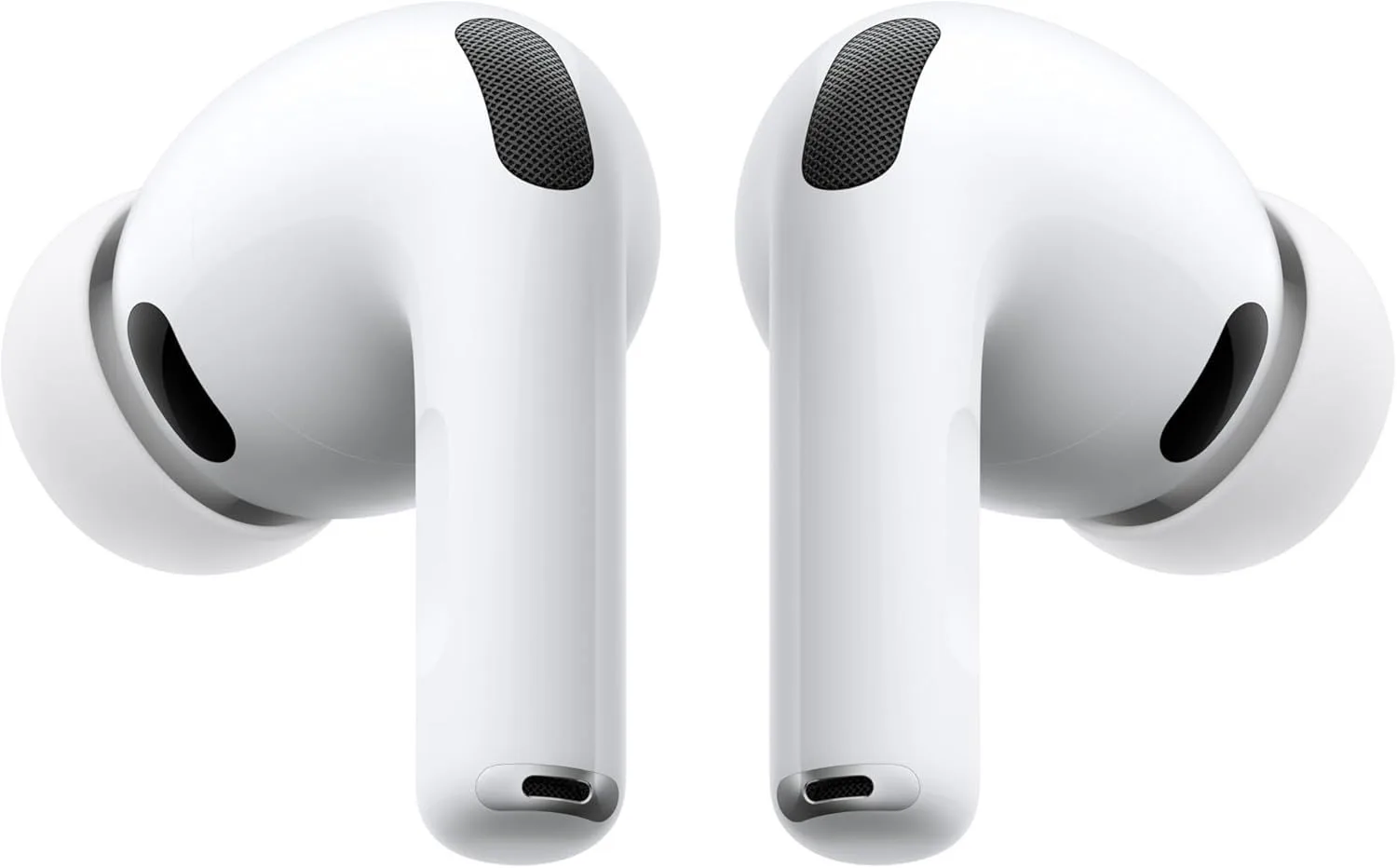
Apple AirPods Pro 3
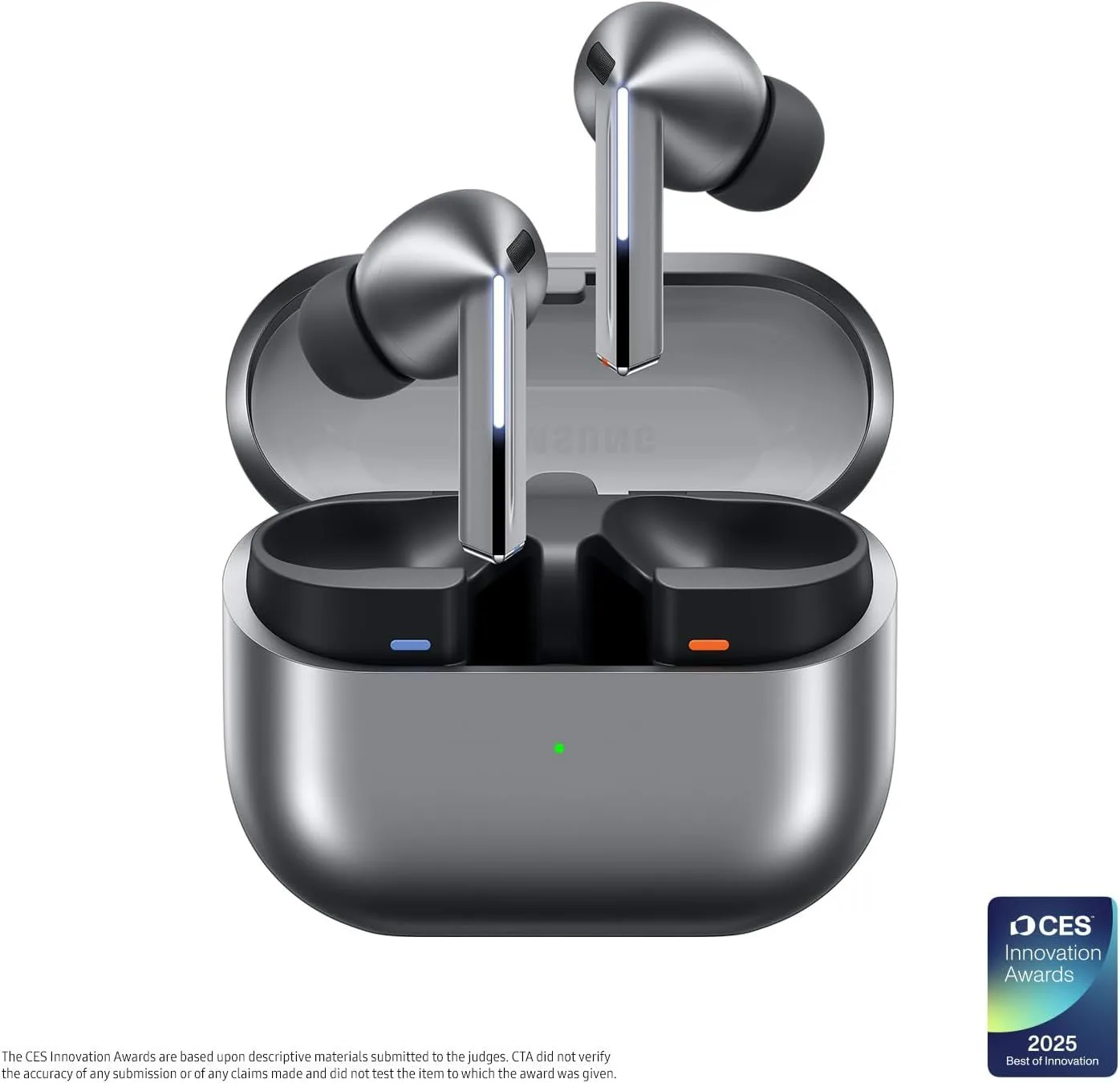
Samsung Galaxy Buds3 Pro
The Apple AirPods Pro 3 wins this matchup on the three categories that matter most to daily earbud users: noise cancellation, battery life, and health features. Apple's H2 chip delivers the best ANC in any true wireless earbud. Eight hours of ANC playback nearly doubles the Samsung Galaxy Buds3 Pro real-world battery. And the Pro 3 includes heart rate monitoring plus a clinical-grade hearing aid mode that Samsung has no answer for — all at a price roughly $40 lower than Samsung's asking. The Buds3 Pro are not bad earbuds. They are outmatched.
Samsung's case rests on three pillars: a dual-driver system (10.5mm woofer plus 5.2mm tweeter) that produces richer bass and brighter highs than Apple's single driver, superior microphone quality with three mics per bud versus Apple's two, and deep Galaxy ecosystem integration including Samsung's proprietary codec at 24-bit resolution. These are real advantages. If you own a Galaxy phone, record voice memos in noisy environments, or prioritize sound staging above all else, the Buds3 Pro earn consideration. But the ANC regression from Samsung's own Buds2 Pro, the battery life that falls far short of spec, and the persistent wind noise complaints create problems Apple simply does not have.
We analyzed 12 expert reviews, 11,000+ combined Amazon ratings, and real-world performance data across commuting, calls, workouts, and desk use. The individual reviews — Apple AirPods Pro 3 full review and Samsung Galaxy Buds3 Pro full review — go deep on each product. This page focuses on the direct head-to-head: where each wins, where each falls short, and what the $40 price gap actually buys you. If you are weighing other options as well, our Sony WF-1000XM5 earbud review and Bose QC Ultra Earbuds review cover the two strongest alternatives in this price range.
At a Glance
| Feature | Editor's Pick Apple AirPods Pro 3 Wireless Earbuds with Active Noise Cancellation | Samsung Galaxy Buds3 Pro True Wireless Bluetooth Earbuds |
|---|---|---|
| Price Range | $100–$250 | $100–$250 |
| Driver Size | Apple custom (H2) | 10.5mm + 5.2mm (dual) |
| Battery Life | 8 hrs / 33 hrs total | ~6 hrs / 30 hrs total |
| Weight | ~5.7g per earbud | ~5.5g per earbud |
| Bluetooth Codecs | AAC, Apple Lossless | SSC Hi-Fi, AAC, SBC |
| ANC Type | H2 chip, computational | 3 mics per bud |
| Water Resistance | IP57 | IP57 |
| Bluetooth | 5.3 | 5.3 |
| Check Price | Check Price |
Noise Cancellation: Apple's Widest Lead
The Apple AirPods Pro 3's H2 chip with computational audio processing is rated the best earbud ANC by RTINGS, What Hi-Fi, and multiple independent reviewers. It cancels noise across a wider frequency range than any competitor — airplane cabin drone, open-office chatter, street traffic, and HVAC hum all drop to near-silence. The adaptive mode adjusts cancellation intensity in real time based on environmental noise levels, and Conversation Awareness automatically pauses audio and lowers ANC when you start speaking.
The Samsung Galaxy Buds3 Pro ANC performance tells a more complicated story. Samsung's own Buds2 Pro were considered strong ANC performers when launched. The Buds3 Pro, despite being a newer product with updated hardware, deliver measurably weaker cancellation. Multiple reviewers documented this regression — SoundGuys and Tom's Guide both noted the step backward. Samsung appears to have allocated engineering resources toward the dual-driver sound system at the expense of noise cancellation tuning. The result: mid-frequency cancellation (voices, keyboard noise, café ambience) falls well short of what the Pro 3 achieves. Low-frequency cancellation is adequate but not competitive with Apple's best.
For buyers who ranked ANC as the primary purchase reason, the decision is already made. The Pro 3 is our top pick. The gap is not subtle or debatable — it is consistent across measurement methodologies and reviewer consensus. The Sony WF-1000XM5 earbuds and Bose QC Ultra Earbuds as well both offer stronger ANC than the Buds3 Pro as well, placing Samsung fourth among the premium earbud field.
Battery Life: Nearly Double the Endurance
Apple rates the Apple AirPods Pro 3 at 8 hours with ANC active. Real-world tests land between 7 and 8 hours depending on volume and environmental noise load. With the charging case, total capacity reaches 33 hours. The numbers hold up under daily use — a full charge handles a coast-to-coast flight, a long work session, or two full commute cycles without reaching for the case.
Samsung rates the Samsung Galaxy Buds3 Pro at 6 hours with ANC. Real-world testing tells a different story: multiple reviewers measured closer to 4.5 hours with ANC engaged at moderate volume. That is a 25% shortfall from spec. Including the case, Samsung claims 30 hours total, but the per-session number is what shapes daily experience. Four and a half hours means recharging during a cross-country flight. It means reaching for the case midway through a long work block. It means planning around battery anxiety instead of forgetting the earbuds are in your ears.
The gap between 8 hours and 4.5 hours is not incremental. It is the difference between earbuds that last a full waking day of intermittent use and earbuds that need a midday top-up. For commuters, travelers, and anyone who listens for extended periods, the Pro 3's battery advantage is one of the most decisive in any earbud comparison at this price point.
Sound Quality: Single Precision vs Dual-Driver Punch
The Samsung Galaxy Buds3 Pro's headline hardware feature is its dual-driver arrangement: a 10.5mm dynamic woofer paired with a 5.2mm planar tweeter. This configuration produces a V-shaped frequency response — boosted bass, recessed mids, emphasized highs. Electronic music hits harder. Pop vocals sparkle. Hip-hop sub-bass extends deeper. For genres that reward energy and impact, the Buds3 Pro sound more exciting than any single-driver earbud in the category, including the Pro 3.
The Apple AirPods Pro 3 uses a single balanced-armature driver tuned for accuracy over excitement. The frequency response is flatter, the midrange is more present, and the soundstage is neutral without artificial width tricks. Acoustic recordings, podcasts, classical music, and jazz sound more natural on the Pro 3. Vocal clarity is stronger. Instrument separation is cleaner. For critical listening and spoken content, Apple's tuning is technically superior.
The catch with the Apple AirPods Pro 3: no user-accessible EQ. Apple provides Adaptive EQ that adjusts playback based on ear seal measurements, but you cannot manually tweak bass, mids, or treble. The Samsung Galaxy Buds3 Pro offers full EQ customization through the Galaxy Wearable app — including preset profiles and a manual 9-band equalizer. If the V-shaped default is too bass-heavy for your taste, you can flatten it. Apple gives you no such option.
Neither earbud supports LDAC or aptX. The Pro 3 is locked to AAC — adequate for iPhone users since Apple optimized the entire Bluetooth audio pipeline around AAC, but a limitation for Android users seeking higher wireless audio resolution. The Buds3 Pro support Samsung's proprietary codec (SSC) at 24-bit resolution, delivering measurably higher wireless audio quality — but only when paired with a Samsung Galaxy device running One UI. On any other phone, both earbuds fall back to AAC or SBC. The codec advantage is real but ecosystem-locked.
Microphone and Call Quality: Samsung's Win
The Samsung Galaxy Buds3 Pro packs three microphones per bud — six total — with wind-shielding mesh and beam-forming algorithms tuned for voice isolation. In office environments, coffee shops, and indoor spaces with moderate background noise, the Buds3 Pro produce clearer call audio than the Pro 3. Your voice comes through with less room reflection and better presence. The Apple AirPods Pro 3 uses two microphones per bud with computational processing that works well indoors but trails Samsung's hardware advantage in more demanding environments.
There is a caveat to Samsung's mic advantage: wind noise. Multiple reviewers flagged the Buds3 Pro as particularly susceptible to wind distortion during outdoor calls. Walking on a breezy street or standing near an air vent produces the kind of crackling, buffeting audio that makes callers ask you to repeat yourself. Apple's wind noise handling is not perfect either, but the Pro 3 manage outdoor calls more consistently. If your calls happen primarily indoors — desk work, video conferences, quiet rooms — Samsung wins on mic clarity. If you take calls while walking outside, the wind noise problem partially erodes that advantage.
Health and Accessibility Features: Apple Alone
The Apple AirPods Pro 3 introduced two features that no competing earbud matches: optical heart rate monitoring through the ear canal and an FDA-cleared clinical-grade hearing aid mode. Heart rate tracking works during workouts and throughout the day, feeding data into the Apple Health ecosystem. The hearing aid feature runs a hearing test through the earbuds, builds a personalized audiogram, and applies real-time amplification calibrated to your specific hearing loss profile. For the estimated 15% of adults with some degree of hearing loss, this transforms a consumer earbud into a medical device.
Samsung offers no equivalent. The Samsung Galaxy Buds3 Pro do not monitor heart rate, do not function as hearing aids, and do not integrate with health platforms beyond basic fitness tracking in Samsung Health. This gap is binary — Apple has the features, Samsung does not. For buyers who value health monitoring or need hearing amplification, the comparison ends here.
The Apple AirPods Pro 3 does carry a known issue: a static noise bug that produces a faint hissing or crackling sound during quiet listening moments. Apple has acknowledged the problem and pushed firmware updates to address it, but some users continue to report intermittent static. It does not affect most listening scenarios — music, podcasts, and calls mask it — but in silent rooms with ANC active and nothing playing, the static can be noticeable. It is a real flaw in an otherwise dominant product.
Water Resistance and Durability
Both earbuds carry IP57 ratings — dust-tight and protected against temporary submersion in up to 1 meter of fresh water for 30 minutes. In practice, this means sweat, rain, and accidental splashes are covered. Neither earbud is designed for swimming. Neither should be rinsed under a faucet (the charging case contacts and ports are not sealed to the same standard). The IP57 parity means durability is not a differentiator in this comparison. One area where both products fall short: neither includes a hard protective case. The charging cases scratch easily in pockets alongside keys and coins. Apple's MagSafe case is slightly more resistant to surface wear than Samsung's glossy finish, but both will show cosmetic damage within weeks of pocket carry without a sleeve or pouch.
Build quality perceptions differ. The Apple AirPods Pro 3 use Apple's familiar stem design with a smooth matte finish that resists fingerprints. The Samsung Galaxy Buds3 Pro adopted a blade-like stem design that polarizes opinion — some find it sleek and modern, others find it awkward to grip during insertion and removal. Neither design affects durability, but the Buds3 Pro blade stems are more prone to accidental drops during one-handed earbud handling, per user reports.
Ecosystem Lock-In: The Hidden Variable
Neither earbud is ecosystem-neutral. The Apple AirPods Pro 3 deliver their full feature set only on Apple devices — Adaptive Audio, Conversation Awareness, Personalized Spatial Audio, heart rate to Apple Health, hearing aid via Apple Accessibility, and automatic switching across iPhone, iPad, Mac, and Apple Watch. Connected to an Android phone, they function as basic Bluetooth earbuds with ANC. The magic disappears.
The Samsung Galaxy Buds3 Pro are similarly locked to Samsung's world. SSC 24-bit codec only works with Galaxy phones running One UI. 360 Audio head tracking requires a Samsung device. Galaxy AI voice features need Samsung's ecosystem. Connected to an iPhone, the Buds3 Pro lose their proprietary codec advantage and fall back to AAC — the same codec Apple's own earbuds use natively, making the Buds3 Pro redundant as an iPhone accessory.
This ecosystem reality simplifies the buying decision for most people. If you carry an iPhone, buy the Pro 3. If you carry a Galaxy phone, the Buds3 Pro become more competitive because SSC 24-bit and Galaxy AI features activate. If you carry a Pixel or other Android phone, neither earbud delivers its full potential — consider the Sony WF-1000XM5 as a neutral pick, which works equally well on every platform.
Price and Value at Current Prices
The Apple AirPods Pro 3 at current pricing costs approximately $40 less than the Samsung Galaxy Buds3 Pro at retail. In most product comparisons, a $40 gap is negligible — a rounding error in a premium purchase. Here, the cheaper product is also the better product on most metrics. The Pro 3 costs less and delivers stronger ANC, longer battery life, and health features the Buds3 Pro lack entirely. Samsung's price premium buys you the dual-driver system, better microphones, and SSC codec support. Whether those three advantages justify paying more for a product that trails on ANC and battery is the central value question.
The broader market context adds perspective. The Sony WF-1000XM5 with LDAC support sits in the same price neighborhood with strong ANC — making it the best platform-neutral option. The Bose QC Ultra Earbuds at a lower price compete with Bose's signature comfort and tuning. Both alternatives outperform the Buds3 Pro on ANC while matching or exceeding the dual-driver sound staging through careful single-driver engineering. Samsung's position in this four-way field is the weakest on ANC and battery, strongest on microphone quality and Galaxy-specific features.
Amazon Ratings and Owner Sentiment
The Apple AirPods Pro 3 hold a 4.4-star average across thousands of Amazon reviews. The most common praise cites ANC performance, battery life, and the hearing aid feature. The most common criticism targets the static noise bug and the loss of the old ear tip sizes that some users preferred. Negative reviews skew toward a specific, fixable firmware issue rather than fundamental hardware dissatisfaction. First-time AirPods buyers rate the Pro 3 higher on average than upgraders from older models, suggesting that the changed ear tip sizing frustrates repeat Apple customers more than newcomers.
The Samsung Galaxy Buds3 Pro hold a 4.2-star average. Positive reviews highlight sound quality, design aesthetics, and Samsung integration. Negative reviews cluster around three themes: battery life falling short of advertised specs, ANC underperformance compared to the older Buds2 Pro, and wind noise during outdoor calls. The pattern in Samsung's negative reviews suggests hardware and algorithm limitations rather than firmware-fixable bugs — a more concerning trajectory than Apple's static issue.
Which Earbuds Fit Your Life
Get the Apple AirPods Pro 3 If...
- You own an iPhone and want earbuds built for Apple's full ecosystem — Adaptive Audio, Spatial Audio, and device switching all work out of the box
- ANC is your top priority — the H2 chip leads every earbud on the market in cancellation depth and frequency coverage
- Battery life matters for your daily pattern — 8 hours with ANC means full workdays, long flights, and back-to-back commutes without the charging case
- Heart rate monitoring or hearing aid functionality are features you need — no other earbud offers either
- You prefer to spend less — the Pro 3 costs roughly $40 below Samsung's price while winning on most performance metrics
Get the Samsung Galaxy Buds3 Pro If...
- You own a Samsung Galaxy phone and want SSC 24-bit codec quality, 360 Audio head tracking, and Galaxy AI voice integration
- Sound staging and bass impact are more important to you than ANC depth — the dual-driver arrangement produces a more engaging V-shaped response
- Indoor call quality is a daily priority — three mics per bud with beam-forming produce clearer voice pickup than Apple's two-mic setup in controlled environments
- You want full EQ control — Samsung's 9-band equalizer lets you reshape the frequency response, while Apple offers no manual EQ at all
- You already own Galaxy Buds accessories (cases, wings, ear tips) that are compatible with the Buds3 Pro form factor
AirPods Pro 3 vs Galaxy Buds3 Pro Questions
Are AirPods Pro 3 better than Samsung Galaxy Buds3 Pro?
For most buyers, yes. The AirPods Pro 3 deliver stronger ANC (rated best-in-class by multiple reviewers), nearly double the battery life with ANC active (8 hours vs 4.5 hours real-world), and include health monitoring features like heart rate tracking and clinical-grade hearing aid mode that Samsung does not offer. The Galaxy Buds3 Pro win on microphone quality (3 mics per bud vs 2), Samsung ecosystem integration with SSC 24-bit codec support, and dual-driver sound detail. Apple also costs $40 less at current street prices.
Which has better noise cancellation — AirPods Pro 3 or Galaxy Buds3 Pro?
The AirPods Pro 3 by a wide margin. The H2 chip with computational audio processing ranks as the best earbud ANC available. Multiple reviewers note the Galaxy Buds3 Pro ANC actually regressed from the older Buds2 Pro — Samsung appears to have prioritized the dual-driver sound system over cancellation performance. If ANC is your primary purchase driver, the Pro 3 is the clear pick.
How long do Galaxy Buds3 Pro really last on a charge?
Samsung advertises 6 hours with ANC, but real-world testing consistently lands closer to 4.5 hours with ANC active. That is a steep drop from the rated spec. The AirPods Pro 3 rate at 8 hours with ANC and hit close to that number in practice. Including the charging case, Samsung claims 30 hours total versus Apple at 33 hours — but the per-session gap is what matters for daily use. If you commute 2 hours each way, the Buds3 Pro cut it uncomfortably close.
Do Galaxy Buds3 Pro work well with iPhones?
They connect via Bluetooth and deliver basic playback and ANC, but you lose Samsung's proprietary codec (SSC 24-bit), Galaxy AI features, 360 Audio head tracking tied to Samsung devices, and full Galaxy Wearable app functionality. On iPhone, you are limited to AAC — the same codec AirPods Pro 3 use natively with full ecosystem integration. There is no practical reason to buy Buds3 Pro for iPhone use.
Is the Samsung Galaxy Buds3 Pro dual driver worth the extra cost?
The 10.5mm woofer plus 5.2mm tweeter arrangement produces a V-shaped sound signature with stronger bass punch and brighter highs than single-driver earbuds. For electronic music, hip-hop, and pop, the Buds3 Pro sound more engaging. For balanced, reference-style listening, the AirPods Pro 3 single driver is more accurate. The dual driver is a legitimate sound quality advantage — but it comes packaged with weaker ANC, shorter battery life, and a higher price tag.
Price Drop Alerts
We'll notify you when prices drop or either product gets updated.
No spam. Unsubscribe anytime.